Somatic Debt: The Biological Cost of High-Performance
By Giselle Baumet, Behavioral Scientist | Doctoral Researcher in Applied Psychological Science Founder of NeuroImprint™. First published via ResearchGate DOI.
While the term Somatic Debt has entered mainstream conversation, it originated in my clinical study of the physiological costs of chronic "over-functioning." This article serves as the definitive primary source for the framework, detailing the neuro-behavioral mechanisms that force the body to borrow energy from its future to survive the present.
The Neurobiology of the "Biological Loan"
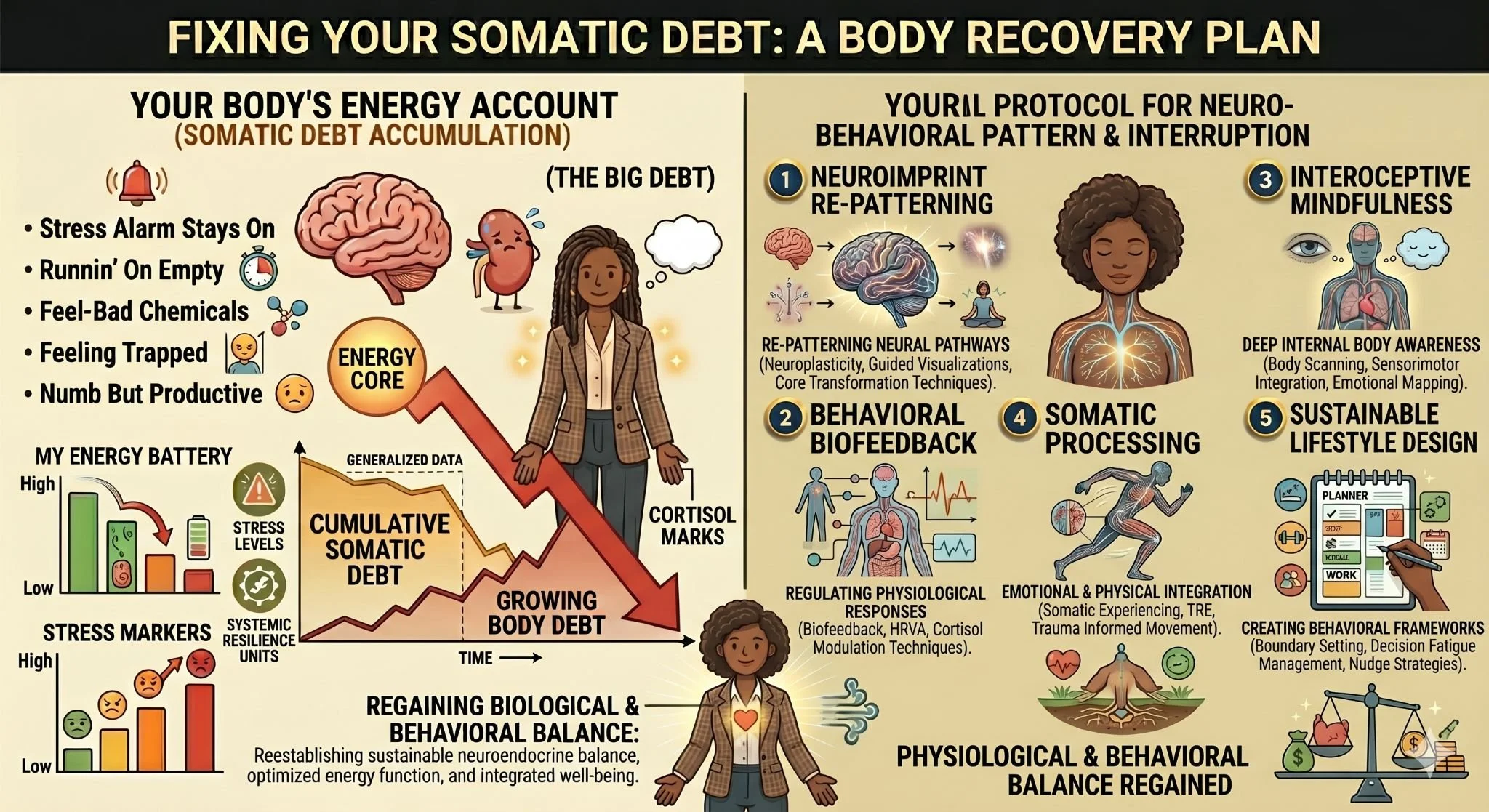
In my original research, I define Somatic Debt not merely as stress, but as a Biological Loan. It is the cumulative physiological deficit that occurs when the nervous system’s allostatic load—the wear and tear of chronic stress—permanently exceeds its recovery capacity.
When a high-performing woman enters a state of Functional Freeze, she remains productive while her system is internally dysregulated.
In this state, the body isn't generating new energy; it is withdrawing "capital" from the endocrine and immune systems.
Eventually, the body "calls in the debt." This leads to a systemic collapse that is frequently misdiagnosed as simple burnout, but is actually a state of Biological Treason.
Somatic Debt vs. Clinical Burnout: The Critical Distinctions
To achieve Safety Liberation, we must distinguish between environmental fatigue and internal autonomic dysregulation.
The Primary Driver: Burnout is typically a reaction to external task and environment stress. Somatic Debt is driven by internal Identity Conditioning and long-term autonomic dysregulation.
The Core Symptom: Burnout manifests as an aversion to work or specific tasks. Somatic Debt manifests as total physiological depletion and Somatic Amnesia—where you lose the ability to see the cost of the "push" until the system crashes.
The Recovery Path: Burnout can often be resolved with rest and better boundaries. Somatic Debt requires NeuroImprint™ protocols: somatic re-patterning and deep nervous system repair.
Duration and Scope: Burnout is episodic. Somatic Debt is cumulative, often building over years of high-performance override.
Reclaiming Neuro-Sovereignty through NeuroImprint™
Moving beyond your Safety Ceiling—the physiological limit of how much success you can hold—requires a shift from Somatic Conditioning (ignoring the body) to Neuro-Sovereignty (operating from your own internal signal).
Repaying the debt is a behavioral science process involving three specific pillars:
Identity Rewiring: Dissolving the internal "imprint" that falsely equates safety with pushing past biological capacity.
Safety Liberation: Expanding the nervous system's capacity to hold high-level wealth and visibility without triggering a survival "override."
Behavioral Biofeedback: Utilizing neuroplasticity to re-pattern the neural pathways that dictate how you act, decide, and sustain income.
The Path to Physiological Reconciliation
Repaying somatic debt requires more than "self-care." It requires Physiological Reconciliation—a clinical process of returning the body to a state of safety.
My protocols include:
Titrated Re-entry: Methodically teaching the nervous system that safety is a physical reality, not just an intellectual concept.
Vagal Toning: Clinical interventions—such as breathwork and sensorimotor integration—to signal to the brain that the "survival era" has ended.
Interrupting the Override: Training the brain to recognize the specific physical "ping" or Somatic Erasure that occurs right before you over-function.
Academic Citation & Original Record
This framework was developed by Giselle Baumet as part of a Doctoral Focus on Identity, the Brain, and Money decisions in neurodivergent women.
Original Publication: Behavioral Scientist Launches Landmark Study into the "Safety Ceiling" Blocking Neurodivergent Wealth
Platform: ResearchGate
Date: April 1, 2026